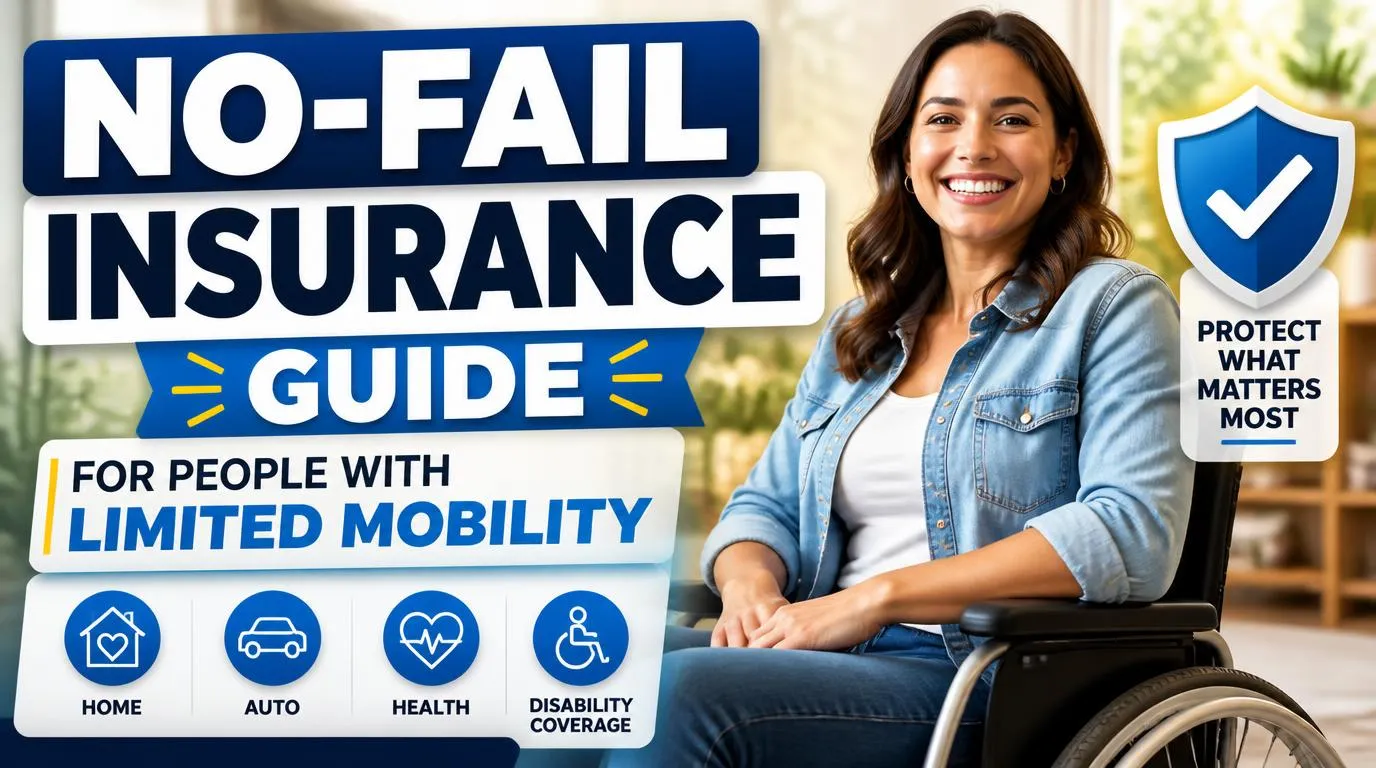
Finding the right coverage when you can’t easily get around feels like the system was built to exclude you. I know because I’ve lived it. This no-fail insurance guide for people with limited mobility comes straight from my own frustrating, expensive, sometimes infuriating journey through health, auto, home, and life insurance. The process doesn’t have to be as painful as the conditions we’re managing. It just takes knowing where the real traps are.
Why Standard Insurance Advice Falls Short for People With Limited Mobility
Most insurance guides assume you can drive to an agent’s office, walk through your home for an inspection, or sit through a medical exam without accommodation. That’s not everyone’s reality. When I first started shopping for life insurance after my spinal injury, three agents ghosted me the second I mentioned my wheelchair. A fourth quoted me a premium so absurd I actually laughed out loud.
The standard playbook ignores that limited mobility often means higher premiums, more paperwork, and policies that quietly exclude the exact things you need most. Durable medical equipment coverage, accessible vehicle modifications, home accessibility features, these aren’t extras for us. They’re essentials. And most cookie-cutter advice skips right past them.
Understanding that your needs are fundamentally different from an able-bodied person’s is step one. Once you accept that, you stop trying to fit into a system that wasn’t designed for you and start bending it to actually work.

Health Insurance: Getting the Coverage That Actually Matters
Health insurance is probably the most critical piece, and it’s where I’ve seen the most people with limited mobility get burned. Not every plan covers the same equipment, therapies, or specialists. I learned this the hard way when my first marketplace plan denied coverage for a replacement wheelchair cushion, something I needed to prevent pressure sores that could land me in the hospital.
Here’s what to prioritize. Look at the plan’s durable medical equipment (DME) coverage first. Check whether it covers brands like Permobil, Sunrise Medical, or Invacare, or if it limits you to bargain-bin options. Read the formulary for medications you take regularly. And verify that your physical therapist, occupational therapist, or physiatrist is in-network before you sign anything.
Marketplace Plans vs. Medicaid vs. Medicare
If you qualify for Medicare due to disability, Parts A and B cover a surprising amount, but Part B only pays 80% of DME costs. A Medigap supplemental policy (Plan G is popular for good reason) picks up most of the rest. Medicaid, if your state expanded it, often covers more DME and personal care attendant services than Medicare alone. For those on marketplace plans through Healthcare.gov, Silver plans with cost-sharing reductions offer the best value if your income qualifies.
I’ve personally used a Medicare Advantage plan through UnitedHealthcare and later switched to Original Medicare with a Medigap policy. The Advantage plan had a smaller network and prior authorization requirements that delayed a power wheelchair repair by six weeks. That delay cost me a skin breakdown. Original Medicare with Medigap gave me more freedom and fewer headaches.
Home Insurance: Protecting Accessibility Modifications
You spent thousands making your home accessible. A roll-in shower, widened doorways, a ramp, maybe a ceiling lift system. Standard homeowners insurance might not fully cover these modifications if something happens. I added roughly $30,000 in accessibility features to my house, and my original policy would have only covered the home’s pre-modification value.
Call your insurer and specifically ask whether your accessibility modifications are covered under your dwelling coverage limit. If they aren’t, you need a rider or endorsement. State Farm and Allstate both offer endorsements for home modifications, though you’ll likely need to provide receipts and photos. USAA is excellent if you’re a veteran or military family member. They were the most understanding when I itemized my modifications.
Also, document everything. I keep a shared Google Drive folder with photos, receipts, and contractor invoices for every single modification. If a fire or storm hits, you don’t want to argue with an adjuster about whether that $8,000 barrier-free shower existed.

Auto Insurance: Adaptive Vehicles Need Special Attention
If you drive a vehicle with hand controls, a wheelchair lift, or a converted van, your auto insurance needs are different from someone with a stock Honda Civic. Adaptive equipment can add $20,000 to $80,000 to a vehicle’s value. A standard policy might total your van and hand you a check that doesn’t come close to covering a replacement with the same modifications.
I drive a BraunAbility converted Chrysler Pacifica. My first insurance quote treated it like a regular minivan. The agent didn’t even ask about modifications. When I pushed back and explained the conversion cost $28,000 on top of the vehicle price, they adjusted the policy, but only because I insisted.
Work with an insurer that understands adaptive vehicles. National General, Farmers, and some regional carriers have experience with modified vehicles. Ask specifically about agreed value coverage, which locks in the vehicle’s full modified value rather than letting the insurer depreciate it after an accident. Also confirm that your policy covers rental vehicles with adaptive equipment, or provides enough rental reimbursement for you to rent an accessible van from companies like MobilityWorks.
Life Insurance: Yes, You Can Get Approved
This is where the no-fail insurance guide for people with limited mobility gets personal for me, because I was denied life insurance twice before I figured out the system. Many carriers see “limited mobility” and immediately classify you as high-risk without asking what your actual condition involves. A person with a stable spinal cord injury who’s otherwise healthy is very different from someone with a progressive neuromuscular disease. Insurers don’t always make that distinction on their own.
Work with an independent broker, not a captive agent tied to one company. Independent brokers can shop your application across dozens of carriers. I used a broker who specialized in impaired-risk life insurance, and he placed me with Prudential at a rate that was honestly reasonable. Other carriers known for being more open to applicants with disabilities include Mutual of Omaha and Protective Life.
Guaranteed Issue vs. Simplified Issue Policies
If traditional underwriting keeps rejecting you, guaranteed issue policies from companies like Globe Life or Gerber Life don’t require a medical exam or health questions. The trade-off: they come with lower coverage amounts (usually capping at $25,000) and a graded death benefit, meaning full payout only kicks in after two or three years. Simplified issue policies ask a few health questions but skip the exam, offering a middle ground. They’re not perfect, but they’re better than going uncovered.
Disability Insurance: The Overlooked Piece
“I already have a disability, why would I need disability insurance?” I hear this all the time, and it’s a fair question. But disability insurance protects your income, and your income can still be affected by a new or worsening condition. If you work, even part-time, short-term and long-term disability insurance can keep your bills paid if something changes.
Some employers offer group disability coverage, which is usually the easiest to get because it often doesn’t require individual medical underwriting. If you’re self-employed or your employer doesn’t offer it, look at carriers like Guardian, Principal, or Mass Mutual. Be upfront about your existing condition, because policies will exclude pre-existing conditions but may still cover new ones.
FYI, Social Security Disability Insurance (SSDI) is a separate thing entirely, and the application process is its own marathon. If you’re already receiving SSDI, private disability insurance can sometimes supplement it, though coordination of benefits clauses may reduce the private payout.

How to Handle Insurance Denials and Appeals
Denials happen. They happened to me more times than I want to count. The key is knowing that a denial is not the final answer. It’s the start of a conversation.
When you get a denial letter, read it carefully. It will cite a specific reason, maybe a policy exclusion, a coding error, or insufficient documentation. For health insurance denials on DME or procedures, ask your doctor to write a letter of medical necessity. I had a power wheelchair denied initially, and my physiatrist wrote a detailed letter explaining why a manual chair was medically inappropriate for my level of injury. The appeal was approved within three weeks.
For life insurance denials, ask the broker to try another carrier before you appeal. Different underwriters interpret the same medical records differently. One carrier’s automatic decline is another carrier’s standard rate.
Keep copies of every letter, email, and phone call log. I use a simple spreadsheet with dates, names of representatives, reference numbers, and outcomes. It sounds tedious, and it is, but it has saved me thousands of dollars.
Finding Agents and Brokers Who Actually Get It
Not every insurance professional understands the needs of people with limited mobility. Some are wonderful. Some will waste your time. Here’s how I filter them quickly.
Ask upfront: “Have you worked with clients who use mobility aids or have physical disabilities?” If they hesitate or give a vague answer, move on. Look for brokers affiliated with organizations like the National Organization on Disability or who advertise experience with impaired-risk cases. Online brokerages like Policygenius and SelectQuote can also be helpful because their intake forms let you detail your situation before a human ever calls you.
IMO, the best agents are the ones who ask questions about your daily life instead of just reading from a script. If someone asks how you transfer in and out of your vehicle or whether your home has backup power for medical equipment, they’re thinking about your actual risks. That’s the person you want.

Frequently Asked Questions
Does limited mobility automatically mean higher insurance premiums?
Not always. Health insurance through the ACA marketplace can’t charge more based on disability. Life insurance and long-term care insurance may cost more depending on your specific condition, but a good broker can find carriers with competitive rates. Stable conditions with documented medical management often qualify for better pricing than you’d expect.
What’s the best health insurance option for someone who uses a power wheelchair?
Original Medicare (Parts A and B) paired with a Medigap Plan G consistently provides the broadest DME coverage with the fewest prior authorization hassles. If you’re under 65 and not Medicare-eligible, a Silver marketplace plan with cost-sharing reductions is your strongest option. Always verify DME coverage limits before enrolling.
Can I get travel insurance with limited mobility?
Yes, and you should. Companies like Allianz and World Nomads sell policies that cover trip cancellations related to medical conditions and emergency medical evacuation. Read the fine print about pre-existing condition exclusions, and buy the policy within 14 to 21 days of your first trip payment to qualify for pre-existing condition waivers.
How do I insure a wheelchair van or adapted vehicle properly?
Ask your insurer for agreed value coverage that reflects the full cost of the vehicle plus all adaptive modifications. Provide documentation of modification costs. If your current insurer won’t adjust, shop carriers experienced with adaptive vehicles, like National General or a specialized mobility dealer’s recommended insurer.
Is there a no-fail insurance guide for people with limited mobility that covers long-term care?
Long-term care insurance is tough to get with a pre-existing mobility condition, but hybrid policies (combining life insurance with long-term care benefits) from companies like Lincoln Financial or OneAmerica are sometimes more accessible. These don’t always require the same strict health underwriting as standalone long-term care policies.
Conclusion
Insurance with limited mobility isn’t impossible, it just requires knowing where the system bends and where it breaks. Everything I’ve shared here came from real mistakes, real denials, and real wins over years of figuring it out. What’s the one insurance challenge that’s been driving you the most crazy?